
Introduction
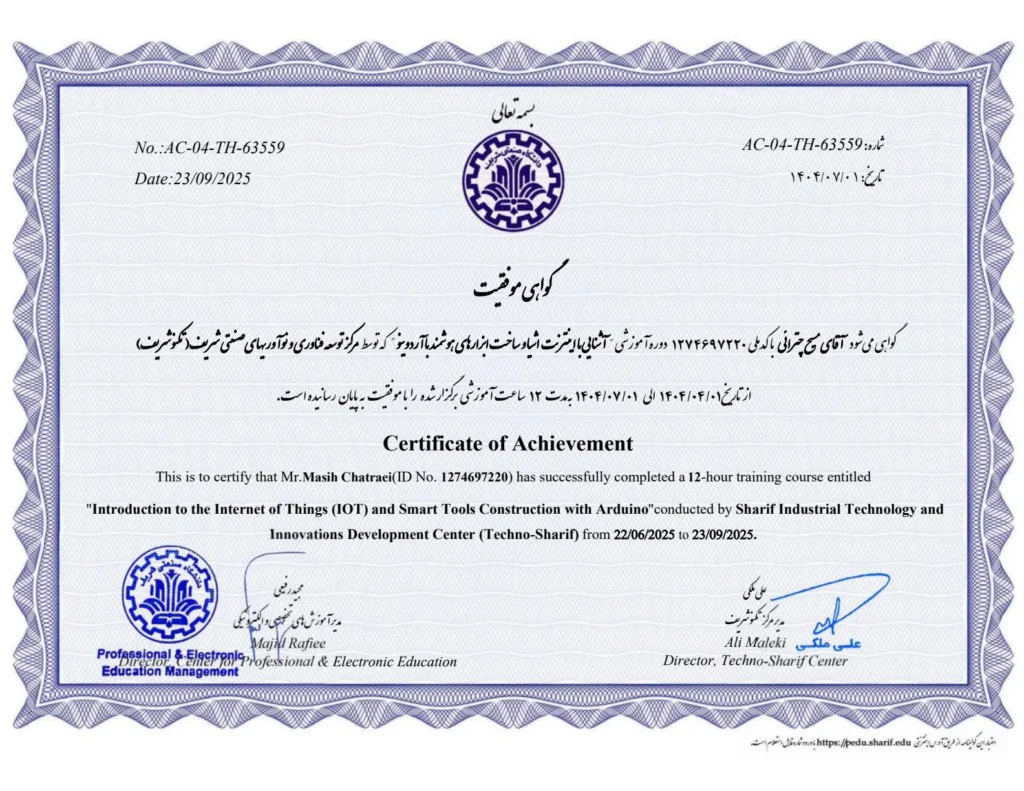
This summer, I enrolled in an intensive training course titled “Introduction to the Internet of Things and Building Smart Devices with Arduino,” offered by TechnoSharif Academy (affiliated with Sharif University of Technology). This course served as a practical starting point for me to transform the concepts I had always studied theoretically into physical reality.
Understanding the Anatomy of a Smart System
The course began with a detailed breakdown of IoT architecture. We dissected the different layers of this ecosystem, from the sensor and actuator layer to the network and application layers. Understanding how a temperature sensor (as the system’s eyes) collects data, how that data is processed, and finally, how an actuator like a fan or a light (as the system’s hands) receives a command, built a solid foundation for me.
It was at this stage that I was introduced to the star of the course: the ESP32 module. This powerful microcontroller, with its built-in Wi-Fi and Bluetooth capabilities, was chosen as the beating heart of most of our projects. We learned why the ESP32 is an ideal choice for IoT projects: affordability, sufficient power, and seamless connectivity.
Stepping into the World of Code and Hardware with Arduino IDE
After grasping the fundamentals, we opened the Arduino Integrated Development Environment (IDE). Programming in C++ for microcontrollers began right at this point. We started from basic concepts like the setup() and loop() functions, working with variables, data types, and operators, and quickly moved towards more practical concepts such as using digital and analog pins, reading sensor values, and controlling outputs.
The first tangible achievement of this phase was setting up a Local Web Server on the ESP32 board itself. This was a small but profoundly impactful project. We wrote code that turned the ESP32 into an independent Wi-Fi access point. By connecting a phone or laptop to this network, a simple web page would open, allowing us to turn connected LEDs on and off. This experience transformed the abstract concept of “the internet” into a tangible, controllable reality.
Synthesizing Knowledge and Building the Final Project
All that theory and small exercises prepared us for the ultimate challenge: designing and building a web-controlled remote car. This project was a test of all the skills we had acquired.
- The Command Center: An ESP32 board.
- The Powertrain: Two DC motors along with a motor driver (like the L298N) to control direction and speed.
- The User Interface: A local web server on the ESP32 with a page containing movement control buttons (Forward, Left, Right, Back, Stop).
- The Build Process: From wiring the circuit and connecting components correctly to writing code that translated commands received from the web browser into signals understandable by the motor driver.
Reaching the moment when pressing the “Forward” button on the mobile page made the car move was an incredible feeling. This car was a complete and tangible example of a simple IoT system: Receiving a command (via the web) ➔ Processing (by the ESP32) ➔ Physical action (motor movement).
The Gains from This Summer Journey
This course was much more than a certificate for me. The most important takeaways were:
- Systematic Understanding: A clear perspective on how to design and implement an IoT system from the ground up.
- Practical Hardware Skills: Hands-on work with development boards, sensors, modules, and circuit debugging.
- Embedded Programming Proficiency: Writing functional code and debugging it in the Arduino environment to solve real-world problems.
- Familiarity with Communication Protocols: Implementing an HTTP web server on a microcontroller as a powerful control method.
- Enhanced Analytical Thinking: Facing challenges like circuit noise, incorrect pin configurations, and finding solutions for them.
Conclusion and a Look Ahead
Participating in this TechnoSharif summer course built a strong bridge between my academic knowledge and the world of implementation and building. Today, IoT and Artificial Intelligence are two sides of the same coin. IoT provides the physical platform for intelligent algorithms to impact the real world. Building that small car proved to me that I can take ideas from the conceptual stage to a working prototype.
My Certificate